
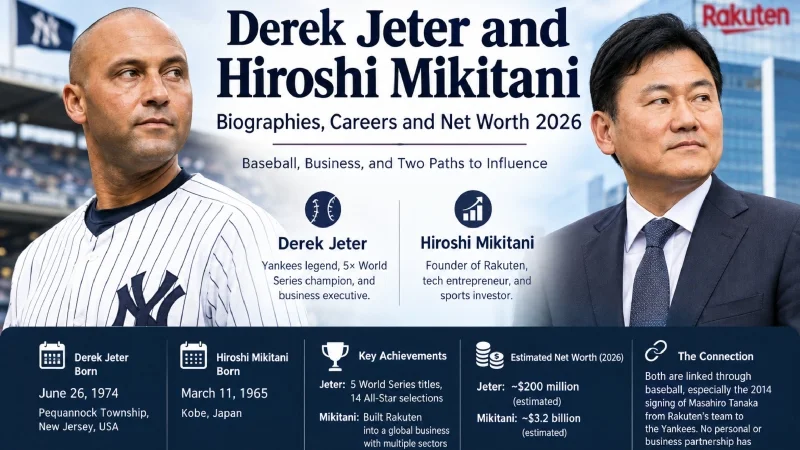

Derek Jeter and Hiroshi Mikitani are prominent figures whose careers have influenced professional sports and business in different ways. Jeter is a former New York Yankees shortstop, five-time World Series champion and Baseball Hall of Fame member. Mikitani is a Japanese entrepreneur best known for founding Rakuten Group and expanding its influence into technology, finance, communications and professional sports.
Although both men have connections to sports ownership and leadership, there is no clearly established public evidence of a direct personal relationship, business partnership or joint professional venture between them. Their shared relevance comes primarily from their involvement in the wider sports and business industries. Understanding their individual achievements provides a more accurate explanation of why their names may appear together in online searches.
Who Is Derek Jeter?
Baseball legend, sports executive and media personality
Derek Jeter is one of the most recognizable figures in American baseball. Born on June 26, 1974, in Pequannock, New Jersey, he grew up in Kalamazoo, Michigan, where his interest in baseball developed into a professional ambition.
His career became closely associated with the New York Yankees, the franchise that selected him sixth overall in the 1992 MLB Draft.
Jeter made his Major League Baseball debut in May 1995. By the following season, he had established himself as the Yankees’ starting shortstop and won the American League Rookie of the Year Award.
His combination of defensive ability, consistent hitting and leadership helped make him a central figure in one of the most successful periods in Yankees history.
Derek Jeter’s Most Important Baseball Achievements
Jeter spent his entire 20-season MLB playing career with the New York Yankees, from 1995 through 2014.
His achievements include:
- Five World Series championships.
- Fourteen MLB All-Star selections.
- Five Gold Glove Awards.
- Five Silver Slugger Awards.
- The 1996 American League Rookie of the Year Award.
- The 2000 World Series Most Valuable Player Award.
- A career total of 3,465 regular-season hits.
One of his most memorable moments came during the 2001 American League Division Series against the Oakland Athletics. His famous defensive play, commonly called The Flip, helped prevent a potential tying run and demonstrated his awareness and quick decision-making.
In 2003, the Yankees appointed Jeter as team captain. He retained that position until his retirement.
His playing career ended in 2014, but his influence on baseball continued beyond the field. In 2020, he was elected to the National Baseball Hall of Fame, receiving 396 of 397 possible votes.
These accomplishments explain why Jeter remains an important figure in discussions about baseball leadership and professional sports management.
Derek Jeter’s Career Beyond Playing Baseball
Jeter’s professional activities did not end when he retired from the Yankees.
In 2013, he launched The Players’ Tribune, a digital media platform designed to allow professional athletes to communicate directly with audiences through personal stories, interviews and original content.
The project introduced a different approach to sports journalism by giving athletes greater control over how they presented their experiences.
Another significant chapter began in 2017 when Jeter joined the ownership group that purchased the Miami Marlins. He became the organization’s chief executive officer and helped oversee its business and baseball operations.
His involvement ended in February 2022, when he and the franchise announced their separation. Jeter also relinquished his ownership interest.
Since 2023, he has worked with FOX Sports as an MLB studio analyst, contributing to the network’s coverage of major baseball events.
His post-playing career demonstrates how an established athlete can move into media, entrepreneurship and sports administration.
Who Is Hiroshi Mikitani?
Japanese entrepreneur, technology executive and sports investor
Hiroshi Mikitani is a Japanese businessman widely recognized as the founder and longtime leader of Rakuten Group, one of Japan’s major internet services companies.
He was born on March 11, 1965, in Kobe, Japan. His educational background includes studies at Hitotsubashi University and an MBA from Harvard Business School, which he received in 1993.
Before establishing his own company, Mikitani worked at the Industrial Bank of Japan, now part of Mizuho Financial Group. His experience in banking and business education helped shape his understanding of finance, entrepreneurship and commercial development.
However, his most important professional decision came when he chose to leave traditional banking and establish an internet business.
The Creation and Growth of Rakuten
Mikitani founded Rakuten in February 1997. The company’s original business concept was an online shopping marketplace that allowed independent merchants to establish digital stores and sell products to customers.
At the time, online shopping was still developing, and many traditional businesses were uncertain about its commercial potential.
Mikitani believed that the internet could give smaller merchants access to customers beyond their immediate geographical markets.
Rakuten developed around this idea, offering merchants opportunities to customize their online stores and build relationships with shoppers.
Over time, the company expanded beyond e-commerce into several business areas, including:
- Financial technology and digital financial services.
- Mobile telecommunications.
- Digital entertainment and content.
- Online travel and shopping services.
- Professional sports and entertainment investments.
Rakuten’s growth established Mikitani as an influential figure in Japan’s technology and entrepreneurial sectors.
According to Rakuten’s corporate management information published in 2026, Mikitani continues to serve as its representative director, chairman and president and CEO.
His business career is significant because he helped develop a Japanese internet company into an international business ecosystem.
Hiroshi Mikitani’s Influence on Professional Sports
Although Mikitani is primarily known as a technology entrepreneur, sports have also become an important part of his business activities.
His involvement extends beyond sponsorship and includes ownership and leadership responsibilities.
Baseball and the Tohoku Rakuten Golden Eagles
One of Mikitani’s major sports investments is the Tohoku Rakuten Golden Eagles, a Japanese professional baseball team.
Rakuten established the franchise in 2004, and the team began competing in Nippon Professional Baseball in 2005.
The franchise achieved an important milestone in 2013 when it won the Japan Series championship.
This success demonstrated Rakuten’s commitment to professional baseball and its interest in building a recognizable sports organization in Japan.
The Golden Eagles also provide an interesting comparison with Jeter’s history. Both men have been associated with baseball organizations, but their involvement has taken different forms.
Jeter developed his reputation through decades of professional competition before becoming a baseball executive. Mikitani approached the sport primarily from the perspective of business ownership and organizational investment.
Football and International Business
Mikitani’s sports interests also include football.
Rakuten became involved with Vissel Kobe, a Japanese professional football club, through its corporate ownership structure.
The club has attracted international attention through its recruitment of internationally recognized players and its participation in Japanese football competitions.
Rakuten has also pursued international sports partnerships and sponsorship arrangements.
These activities demonstrate how Mikitani has used sports as part of a broader corporate strategy involving international visibility, entertainment and commercial relationships.
Derek Jeter and Hiroshi Mikitani: Is There a Connection?
This is the central question behind the combined keyword.
Derek Jeter and Hiroshi Mikitani have similarities in their professional interests, particularly their involvement in sports organizations and business leadership.
However, similarities do not establish a personal or professional relationship.
A review of their publicly available biographies, corporate records and official career information does not establish that they have worked together, entered a business partnership, shared ownership of a sports organization or maintained a documented personal relationship.
Their careers are better understood independently.
Jeter’s connection to baseball comes from his playing achievements, leadership of the Yankees, later involvement with the Miami Marlins and continued work in sports broadcasting.
Mikitani’s connection to sports comes through Rakuten’s ownership and investment activities, including professional baseball and football.
Both have experience beyond their original professional specializations. Nevertheless, their respective business histories do not establish a direct collaboration.
It is important to make this distinction because search terms containing two public figures’ names can sometimes suggest a connection that the available evidence does not support.
What Human Research and Public Records Actually Establish
A reliable examination of Derek Jeter and Hiroshi Mikitani requires more than comparing their names or identifying similarities in their careers.
The strongest approach is to examine original records and independently established professional histories.
Several sources provide useful evidence:
1. Baseball Hall of Fame records: Jeter’s official Hall of Fame biography confirms his playing career, Yankees achievements, statistics and 2020 induction.
2. Major League Baseball records: MLB’s reporting confirms Jeter’s departure from the Miami Marlins in February 2022. This is important because older biographies sometimes continue to describe him as the franchise’s CEO.
3. Rakuten corporate records: The company’s official management information identifies Mikitani’s leadership position and documents important milestones in his professional career.
4. Harvard Business School: Its published founder profile provides additional background about Mikitani’s education, decision to establish Rakuten and entrepreneurial philosophy.
5. FOX Sports: Its professional biography identifies Jeter’s current broadcasting role and provides information about his activities after retirement.
When these records are considered together, they establish two separate professional histories.
They also show why it would be inaccurate to describe Jeter and Mikitani as business partners or close associates without additional documentary evidence.
This distinction is particularly important for biography articles. Readers should be able to separate verified relationships from similarities, speculation and search-engine associations.
Comparing Derek Jeter and Hiroshi Mikitani
Although their careers developed in different countries and industries, comparing their professional achievements highlights two different approaches to leadership.
| Category | Derek Jeter | Hiroshi Mikitani |
|---|---|---|
| National background | American | Japanese |
| Main profession | Former professional baseball player | Entrepreneur and business executive |
| Best known for | New York Yankees | Rakuten Group |
| Major achievement | Five World Series championships | Building Rakuten into a major internet services company |
| Sports involvement | Baseball player and former team executive | Sports team owner and investor |
| Education | University of Michigan attended | Hitotsubashi University and Harvard Business School |
| Current professional role | FOX MLB studio analyst | Rakuten chairman and CEO |
The most interesting difference is how each developed influence.
Jeter built his reputation through individual sporting performance, team achievements and public leadership. Mikitani built his through entrepreneurship, business expansion and investment across multiple industries.
Their careers illustrate two different ways of becoming influential in professional sports and business.
Important Career Timeline
The following timeline highlights selected milestones from both careers.
| Year | Derek Jeter | Hiroshi Mikitani |
|---|---|---|
| 1992 | Selected by the Yankees in the MLB Draft | — |
| 1993 | — | Earned MBA from Harvard |
| 1995 | Made MLB debut | — |
| 1996 | Won AL Rookie of the Year | — |
| 1997 | — | Founded Rakuten |
| 2000 | Won World Series MVP | — |
| 2003 | Became Yankees captain | — |
| 2004 | — | Became involved in Japanese professional baseball |
| 2009 | Won fifth World Series championship | — |
| 2013 | Founded The Players’ Tribune | — |
| 2014 | Retired from professional baseball | — |
| 2017 | Joined Miami Marlins ownership group as CEO | Continued expanding Rakuten’s sports activities |
| 2020 | Elected to Baseball Hall of Fame | Continued leading Rakuten |
| 2022 | Left the Miami Marlins | Continued his corporate leadership |
| 2023 | Joined MLB on FOX | Continued leading Rakuten |
This timeline shows that their most important achievements developed independently. It does not establish a shared business venture or personal association.
Why Are People Searching for Derek Jeter and Hiroshi Mikitani Together?
There are several possible reasons why readers may encounter these names together.
First, both are influential figures in professional sports organizations. Jeter’s career includes the New York Yankees and Miami Marlins, while Mikitani has invested in Japanese professional baseball and football.
Second, both have experience in business leadership outside their original professional activities.
Third, international sports ownership and commercial partnerships frequently bring together executives, investors, athletes and media personalities. This broader environment can create search interest in people whose careers have overlapping themes.
However, these are explanations for why the names might attract combined search interest, not proof of a particular event or relationship between the two men.
Without reliable documentation, it would be inappropriate to claim that they have met, collaborated or conducted business together.
Frequently Asked Questions (FAQs)
1. Who are Derek Jeter and Hiroshi Mikitani?
Derek Jeter is a former American professional baseball player best known for his career with the New York Yankees. Hiroshi Mikitani is a Japanese entrepreneur and founder of Rakuten Group. Both have influenced professional sports and business.
2. Are Derek Jeter and Hiroshi Mikitani business partners?
There is no established public evidence confirming that Derek Jeter and Hiroshi Mikitani are business partners or have jointly operated a company.
3. What is Derek Jeter famous for?
Jeter is famous for his 20-season career with the New York Yankees, five World Series championships, 3,465 career hits and induction into the Baseball Hall of Fame in 2020.
4. What company did Hiroshi Mikitani establish?
Hiroshi Mikitani founded Rakuten in February 1997. The company developed into a major Japanese internet services group with operations across e-commerce, financial technology, telecommunications and digital content.
5. What connects Derek Jeter and Hiroshi Mikitani?
Their most apparent common interest is professional sports. Jeter became a baseball legend and later a sports executive, while Mikitani developed sports investments through Rakuten. A direct personal or business relationship between them has not been established by the public records reviewed.
Conclusion
Derek Jeter and Hiroshi Mikitani represent two different forms of professional achievement. Jeter established his legacy through baseball excellence, championship success and leadership, while Mikitani built an influential business through entrepreneurship, technology and sports investment.
Although their professional interests overlap in the wider sports industry, available public information does not establish a direct relationship or business partnership between them.
Understanding their individual achievements provides the clearest and most reliable explanation of why these two names may appear together in online searches.
Read more:Soy Carmín: The Story, Ownership, History and Digital Presence of the Mexican Lifestyle Platform
