


Droven IO tech education trends point toward a skills-first future. AI-assisted learning, cloud practice, automation, and shorter training paths now matter more. However, one important distinction is often missed: the term “Droven IO” is not consistently described across public sources. Some sites present it as an informational technology platform, while others use the phrase more broadly for emerging digital-learning trends.
That distinction matters. Instead of repeating promotional claims, this guide examines the trends against independent evidence from the OECD, UNESCO, and World Economic Forum.
Droven IO Tech Education Trends: 30-Second View
| Trend | What Is Changing | Why It Matters |
|---|---|---|
| Generative AI | AI becomes a tutor and assistant | Faster, personalized support |
| Skills-first learning | Ability matters alongside qualifications | Better career alignment |
| AI literacy | Learners must understand AI use | Essential workplace knowledge |
| Cybersecurity | Security skills keep growing | Strong employer demand |
| Automation | Routine workflows become automated | Workers need new digital skills |
| Microlearning | Training becomes shorter | Easier continuous upskilling |
| Human skills | Critical thinking stays important | AI cannot replace judgment |
| Responsible AI | Privacy and verification gain focus | Safer technology use |
What Does “Droven IO Tech Education Trends” Actually Mean?
The phrase needs careful handling.
A public Droven.io description presents the site as an informational platform covering artificial intelligence, robotic process automation, digital transformation, and future technology. It says the platform provides educational information rather than enterprise automation products.
However, another published analysis takes a more cautious position. It describes “Droven IO” as a developing concept around practical technology education, rather than a clearly documented standalone education system.
Therefore, readers should not automatically treat every “Droven IO trend” as a proprietary technology. The safer interpretation is a collection of themes surrounding modern tech learning.
That includes AI, automation, cloud skills, digital careers, and continuous education.
Verification note: Publicly available information remains limited regarding Droven.io’s ownership, enrollment figures, accreditation, proprietary learning technology, or independently audited educational outcomes. Those details should remain unconfirmed unless primary evidence becomes available.
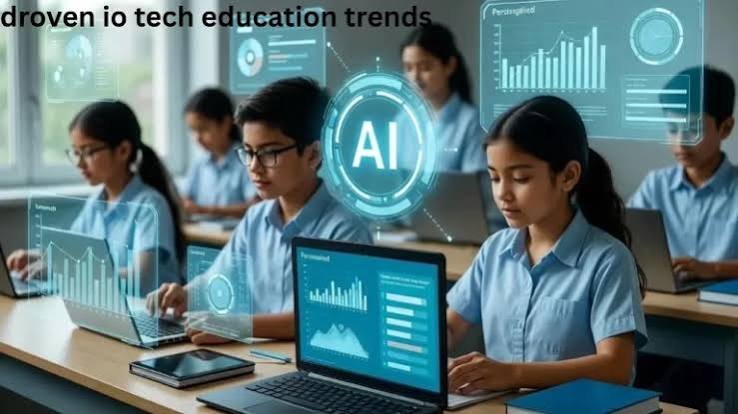
The Biggest Change: AI Is Moving From Tool to Learning Partner
Generative AI is the strongest education technology story of 2026.
However, simply giving students an AI chatbot does not guarantee learning. The OECD Digital Education Outlook 2026 makes this distinction especially clear.
The OECD reports that 37% of lower-secondary teachers used AI for their work in 2024. Moreover, 57% believed AI helps create or improve lesson plans. At the same time, 72% believed it can threaten academic integrity.
This creates a useful way to judge Droven IO-style AI learning.
| Weak AI Learning | Strong AI Learning |
|---|---|
| AI writes the complete answer | AI explains difficult concepts |
| Student copies output | Student checks and improves output |
| AI replaces thinking | AI challenges the learner |
| No source verification | Claims get independently checked |
| Same response for everyone | Support adapts to learning needs |
The OECD warns that better AI-assisted task performance does not automatically produce stronger learning. Students can produce impressive work while developing fewer independent skills.
Therefore, AI-assisted learning should not become AI-dependent learning.
That is one of the most important education trends to watch.
Skills Are Becoming the New Learning Currency
Tech education increasingly connects learning with demonstrable abilities.
The reason becomes clearer when employment data enters the picture.
The World Economic Forum Future of Jobs Report 2025 ranks AI and big data as the fastest-rising skill area. Networks and cybersecurity follow, while technological literacy also ranks near the top.
The change goes beyond technical abilities.
Employers also expect greater importance for:
- creative thinking;
- resilience and flexibility;
- curiosity and lifelong learning;
- analytical thinking;
- leadership skills.
Furthermore, the World Economic Forum estimates that almost 40% of workers’ core skills could change by 2030. It also reports that 63% of surveyed employers consider skills gaps a major barrier to business transformation.
This helps explain why shorter, targeted technology education attracts attention.
A learner may not need another broad course. Instead, they might need one specific capability: cloud deployment, AI evaluation, cybersecurity basics, data analysis, or workflow automation.
A Better Way to Read the Trend: Learn in Skill Stacks
Here is a more useful model than simply collecting certificates.
The Skill-Stack Model
| Layer | Example Skill | Purpose |
|---|---|---|
| Foundation | Digital literacy | Understand modern tools |
| Core | AI and data literacy | Work intelligently with AI |
| Applied | Cloud or automation | Complete real tasks |
| Protection | Cybersecurity awareness | Reduce digital risks |
| Human | Critical thinking | Judge AI-generated information |
| Proof | Portfolio project | Demonstrate capability |
This model reveals something important.
The future learner may not study one technology career. Instead, people will increasingly build combinations of complementary skills.
For example, someone working in marketing could combine AI prompting, analytics, workflow automation, privacy awareness, and communication.
A finance employee might combine spreadsheets, data visualization, AI verification, cybersecurity, and automated workflows.
This is a stronger interpretation of skills-first education because it connects technology directly with an existing profession.
Automation Literacy Could Become as Important as Computer Literacy
Automation is another recurring theme around Droven IO content.
Yet future workers do not necessarily need advanced programming skills.
Many need automation literacy instead.
That means understanding:
Input → Rule → Automated Action → Output → Human Check
Consider an invoice workflow. Software receives an invoice, extracts information, checks defined conditions, sends the record onward, and flags unusual cases.
A worker overseeing that process needs more than button-clicking ability. They must recognize incorrect data, failed rules, security risks, and situations requiring human judgment.
This creates a different educational goal.
Students should learn how automated systems behave, not merely which software buttons to press.
That knowledge also transfers between tools. Interfaces change quickly, but workflow logic lasts longer.
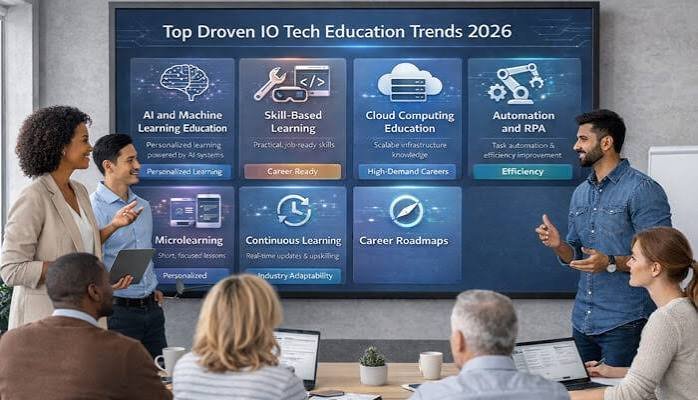
Cloud Learning Is Moving Toward Practice
Cloud computing remains another useful skill area.
Traditional technology education often explains cloud concepts through definitions. Modern training increasingly benefits from practical environments where learners configure, test, break, and repair systems.
This creates an important distinction.
| Theory-Heavy Learning | Practice-Driven Learning |
|---|---|
| Define cloud computing | Deploy a simple cloud workload |
| Memorize commands | Use commands in context |
| Read security rules | Configure permissions |
| Study failures | Troubleshoot an actual failure |
| Complete quizzes | Build portfolio evidence |
The second approach better reflects real technical work.
However, foundational theory still matters. Practice without understanding can create workers who know one interface but cannot solve unfamiliar problems.
The strongest programs combine both.
Microlearning Is Useful — But It Has a Hidden Weakness
Short learning modules fit modern schedules.
A professional can study one topic after work. Students can complete small modules between larger commitments. Companies can also update focused lessons faster than entire degree programs.
However, microlearning creates a fragmentation problem.
Knowing ten disconnected tricks does not equal understanding a system.
Therefore, short lessons work best when they form a deliberate sequence:
Concept → Guided Exercise → Independent Task → Feedback → Real Project
This structure converts small lessons into cumulative knowledge.
Without that connection, learners risk collecting certificates without developing deep competence.
AI Makes Assessment More Important, Not Less Important
Education once treated homework as evidence that someone understood a subject.
Generative AI complicates that assumption.
A polished essay, working code sample, or detailed explanation can now be created with substantial AI assistance. Consequently, educators need stronger ways to measure actual understanding.
The OECD highlights similar concerns. It reports that many teachers worry about academic integrity and emphasizes preserving independent thinking alongside AI-supported education.
Assessment may therefore shift toward:
- live problem-solving;
- project demonstrations;
- oral explanations;
- version histories;
- supervised practical work;
- explaining why a solution works.
The important question changes from “Did you produce this?” to “Can you explain, test, and improve this?”
That shift may become one of AI’s biggest long-term effects on education.
The Missing Trend: Responsible AI Literacy
Many trend articles celebrate AI personalization. Fewer explain the responsibility attached to it.
The UNESCO guidance on generative AI in education calls for a human-centered approach. Its recommendations emphasize data privacy, appropriate use, human agency, and careful validation of AI systems.
That means future AI education should teach more than prompting.
Learners should understand:
verification, bias, privacy, copyright awareness, data handling, limitations, and human oversight.
For example, students should know why confidential information should not casually enter public AI systems. They should also recognize that fluent AI-generated answers can still contain errors.
Therefore, responsible AI literacy deserves a place beside coding and cybersecurity.
What Should Students Actually Learn in 2026?
The strongest evidence suggests a balanced learning path.
| Priority | Learn | Practice |
|---|---|---|
| 1 | AI literacy | Prompt, evaluate, verify |
| 2 | Data basics | Analyze real datasets |
| 3 | Cybersecurity | Permissions and safe practices |
| 4 | Cloud concepts | Deploy simple projects |
| 5 | Automation | Build basic workflows |
| 6 | Critical thinking | Challenge AI outputs |
| 7 | Communication | Explain technical decisions |
| 8 | Continuous learning | Update skills regularly |
This direction matches employer expectations.
The World Economic Forum identifies big data specialists and AI and machine-learning specialists among the fastest-growing roles. Software developers also rank among rapidly growing professions.
Still, technical knowledge alone is insufficient.
The same workforce research highlights creativity, resilience, analytical thinking, and lifelong learning.
A Practical “Proof-of-Skill” Test
Before paying for any course associated with Droven IO tech education trends, ask five questions.
Can I build something afterward?
A useful course should create practical capability.
Can I explain the technology without AI?
Otherwise, the tool may be doing the learning.
Can I troubleshoot mistakes?
Real workplaces rarely provide perfect examples.
Can I verify AI-generated information?
AI literacy includes skepticism and source checking.
Can I show evidence of my skill?
Projects make learning visible.
This test is more valuable than chasing every new EdTech buzzword.
What Comes Next?
The next stage of tech education will probably not eliminate teachers, universities, or longer qualifications.
Instead, learning models will overlap.
Formal education can provide foundations and deep expertise. Short courses can update fast-changing skills. AI can provide immediate support. Projects can demonstrate competence. Employers can then evaluate what learners can actually do.
The OECD’s 2026 evidence strongly supports purposeful rather than automatic AI adoption. AI works best when teaching design protects genuine cognitive effort.
That gives Droven IO tech education trends a more meaningful interpretation.
The future is not simply more technology in education.
It is better-designed learning around technology.
Final Takeaway
Droven IO tech education trends reflect several genuine changes: AI-supported education, practical skills, automation literacy, cloud learning, and continuous upskilling.
However, readers should separate broad education trends from claims about Droven.io itself. Public evidence does not currently establish every feature or outcome attributed to the name across third-party articles.
The strongest 2026 learning strategy is therefore simple: use AI without surrendering thinking, build practical skills, create proof of work, protect data, and keep learning as technology changes.
That approach aligns far more closely with current OECD, UNESCO, and World Economic Forum evidence than chasing technology hype.
Read more:How to Install Bvostfus Python Safely: What You Should Verify First
